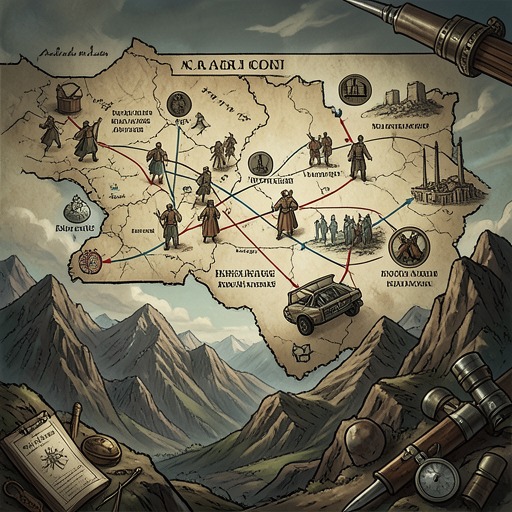
Jaredite final battle
Book of MormonThe Jaredite final battle is the last and most destructive phase of the Jaredite wars, centered on the pursuit and confrontation of Coriantumr and Shiz. It begins after violence has spread across the land without restraint and ends with Coriantumr striking off Shiz’s head after nearly two million people have already died. The battle’s decisive significance lies in its reversal of the usual meaning of victory: Coriantumr defeats his last great opponent, yet the Jaredite people and political order are effectively destroyed.
Causes and Background
The conflict grows out of a land-wide breakdown in which people are shedding blood and no one remains able to restrain them. The violence is not presented as a contained dispute between two commanders; it becomes a social condition that draws cities, families, and armies into an expanding cycle of retaliation. Shiz, identified as the brother of Lib, pursues Coriantumr after overthrowing many cities and killing women and children. His campaign therefore carries the war beyond the battlefield, making civilian destruction part of the conflict’s advance.
The armies begin to gather throughout the land. Their movement creates a vast concentration of armed populations rather than a single decisive engagement, and the repeated mustering suggests that the war has absorbed the society’s remaining resources and loyalties. The conflict’s central opposition is consequently both personal and collective: Shiz pursues Coriantumr, while entire peoples flock into armies around the two leaders. The Jaredite final battle is the culmination of this convergence, not an isolated clash with an unrelated cause.
Course of the Battle
Shiz’s pursuit initially drives Coriantumr’s forces before him. The scale of the destruction becomes so great that Shiz eventually orders his people not to continue pursuing Coriantumr’s armies, and they return to their camp. This temporary withdrawal does not end the war. It marks only a pause in a conflict whose momentum has already exceeded the capacity of its leaders to control it.
When Coriantumr recovers, he sees the consequence of the preceding fighting: nearly two million of his people have already been slain. The number includes two million mighty men as well as the broader population described in the account, and Coriantumr responds with sorrow. His recognition is crucial because it exposes the cost of the struggle from within the surviving leadership. The campaign has not brought security or meaningful political recovery; it has converted the defense of a people into the destruction of that people.
The armies fight again on the following day. At night, all but fifty-two of the combatants have fallen by the sword. The survivors sleep upon their swords, a stark image of exhaustion and continued militarization: even rest occurs with weapons beneath them, and the objects of war have become both protection and bedding. The following fighting reduces the remnant still further. The battle’s rhythm is therefore marked by recurrence rather than resolution—pursuit, withdrawal, renewed combat, nightfall, and another day of slaughter.
Coriantumr and Shiz
The final encounter brings the two leaders together after the armies have been reduced to almost nothing. Coriantumr leans upon his sword and rests for a little while before striking off Shiz’s head. The action gives Coriantumr a literal victory over his rival, but the surrounding circumstances make the victory profoundly tragic. He does not overcome Shiz at the head of a functioning kingdom; he kills him after the armies and population have been nearly annihilated.
Shiz’s death closes the personal pursuit that has organized the final phase of the war, but it does not repair the devastation caused by that pursuit. The narrative places the bodily act of decapitation beside the vast earlier death toll, forcing the reader to measure the apparent triumph against its human cost. Coriantumr’s sword ends Shiz’s life, yet it cannot end the consequences of the war or restore the society that the two leaders have helped consume.
Consequences and Aftermath
The Jaredite final battle functions as a terminal collapse rather than a successful succession struggle. The evidence of nearly two million dead, followed by the reduction of the surviving armies to fifty-two and then to an even smaller remnant, shows that the conflict has stripped the Jaredite world of ordinary continuity. Cities have been overthrown, women and children have been killed, and the people have been gathered into armies until the distinction between national survival and total mobilization disappears.
The account also places this catastrophe within the larger record transmitted through Moroni. The Jaredite history is an abridgment presented as a warning to the remnant of the house of Israel and as evidence of what the Lord has done for earlier peoples. The final battle thus stands in relation to other histories preserved in the record, including the account that Mosiah discovered of the people of Zarahemla, who had come from Jerusalem when Zedekiah was carried captive into Babylon. These linked records make the Jaredite destruction more than an isolated ancient war: it becomes one part of a broader historical pattern in which peoples are scattered, preserved through records, and judged through the consequences of collective choices.
The narrative’s wider prophetic horizon also contrasts the Jaredite ending with promises of divine manifestation, the gathering of the house of Israel, and the appearance of Jesus Christ. Those promises do not erase the final battle’s material devastation. Instead, they sharpen its significance. A record intended to convince Jew and Gentile that Jesus is the Christ preserves the Jaredite ruin as a testimony that covenant history includes both preservation and catastrophic loss. The battle ends the Jaredite political world, while the surviving record carries its warning beyond that world’s disappearance.